
What Is a Capacitor?
A capacitor is an electrical component that stores and releases energy to support a motor or control electrical flow. In a ceiling fan, the capacitor helps create the phase shift needed for the motor to start and maintain rotation. Its value affects motor performance, fan speed, and operating behavior.
Quick Facts About Capacitor
Category
Motor support component
Used for
Starting and controlling motor operation
Common confusion
Often confused with a circuit breaker
Also called
Condenser, Motor capacitor
Often discussed with
Ceiling Fan Repair
Key Takeaways About Capacitor
- A capacitor stores electrical energy for controlled release.
- Ceiling fans use capacitors to support motor speed.
- A capacitor is not the same as a circuit breaker.
How Capacitor Works
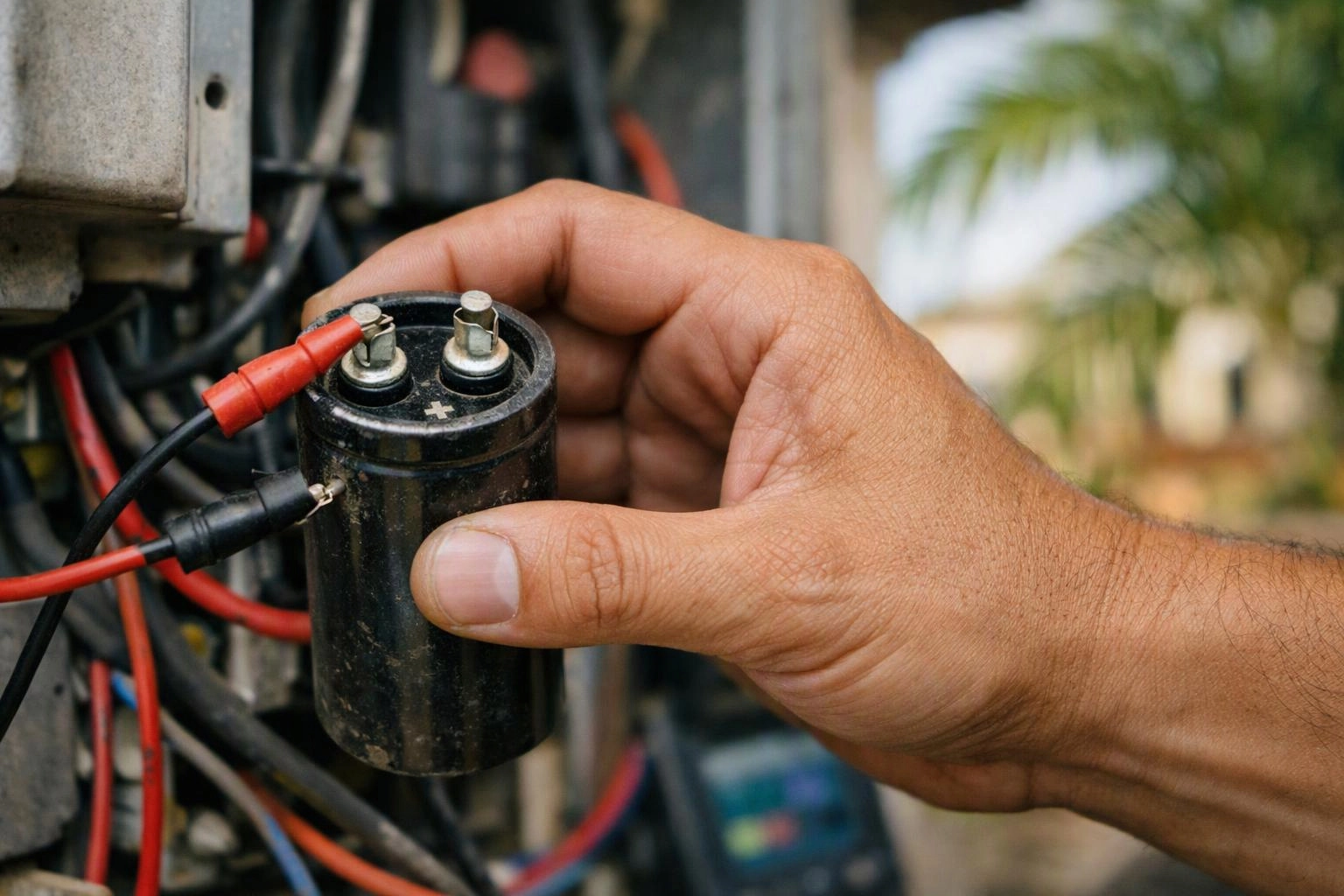
A capacitor stores electrical energy in an electric field and releases that energy as the connected circuit needs it. In a ceiling fan, the capacitor shifts the timing of current reaching the motor windings. That shift creates the electrical conditions the motor needs to start turning and continue running.
Related glossary terms: Ballast, Dimmer switch, Electrical load.
The capacitor value works with the motor design and fan controls. A faulty capacitor may cause slow starting, weak airflow, limited speed control, or a humming motor that does not turn. Ceiling fan controls may send power through different capacitor sections to select different speeds. Testing requires checking the component and the motor circuit together, since similar symptoms can come from wiring, controls, or the motor itself.

From the Earth Electric team
When we inspect a ceiling fan, we check the capacitor alongside the fan controls, motor wiring, and mechanical operation. We look for symptoms that match a capacitor fault, then verify the circuit condition before identifying the component as the cause. Our team also checks that the replacement matches the fan's electrical requirements.
Capacitor in Practice: A Real-World Example
A ceiling fan may hum after its control is switched on, while the blades remain still or move slowly. A technician checks the capacitor and related motor connections to determine whether the component is preventing normal starting and speed control.
Related Services
Related Terms
Ballast
Ballast is an electrical component that controls current in fluorescent or other gas-discharge lighting. The ballast…
Dimmer switch
A dimmer switch is a wall control that adjusts the electrical power sent to a compatible…
Electrical load
Electrical load is the amount of electrical power that connected equipment draws from a circuit or…
Voltage drop
Voltage drop is the reduction in electrical pressure that occurs as current travels through a conductor…
Earth Electric
Have Questions About Capacitor?
Contact Earth Electric for practical guidance on Capacitor and related 24 hour electrician work in Miami.