
What Is an Arc Flash?
Arc flash is a sudden electrical discharge that travels through air between energized conductors or between a conductor and ground. The discharge releases intense heat, bright light, sound, and pressure. Arc flash can damage equipment and injure people nearby, especially when loose connections, damaged insulation, contamination, or incorrect protective devices allow current to follow an unintended path.
Quick Facts About Arc flash
Category
Electrical safety hazard
Used for
Assessing energized equipment and protective measures
Common confusion
Often confused with a ground fault or short circuit
Also called
Arc-flash event, Electrical arc flash
Often discussed with
Electrical Safety Inspection, Electrical Code Correction
Key Takeaways About Arc flash
- An arc flash travels through air instead of a normal circuit path.
- Loose connections and damaged insulation can increase arc flash risk.
- Arc flash is not the same event as a ground fault.
How Arc Flash Works

Arc flash begins when electricity leaves its intended conductive path and crosses an air gap. The air becomes conductive, creating a bright electrical arc between conductors or between a conductor and grounded metal. Heat and pressure spread outward from the arc, while molten metal and damaged insulation can add to the event.
Related glossary terms: Ground fault, Circuit overload, Wire gauge.
Electrical professionals assess arc flash by reviewing the equipment, available fault current, conductor condition, enclosure design, and protective device operation. A safety inspection may look for loose terminations, exposed energized parts, moisture intrusion, and signs of overheating. Arc-flash boundary describes the area where a person could receive a serious burn from the released energy. Ground fault describes current flowing to ground through an unintended path, which can contribute to an arc flash but is not identical to it.
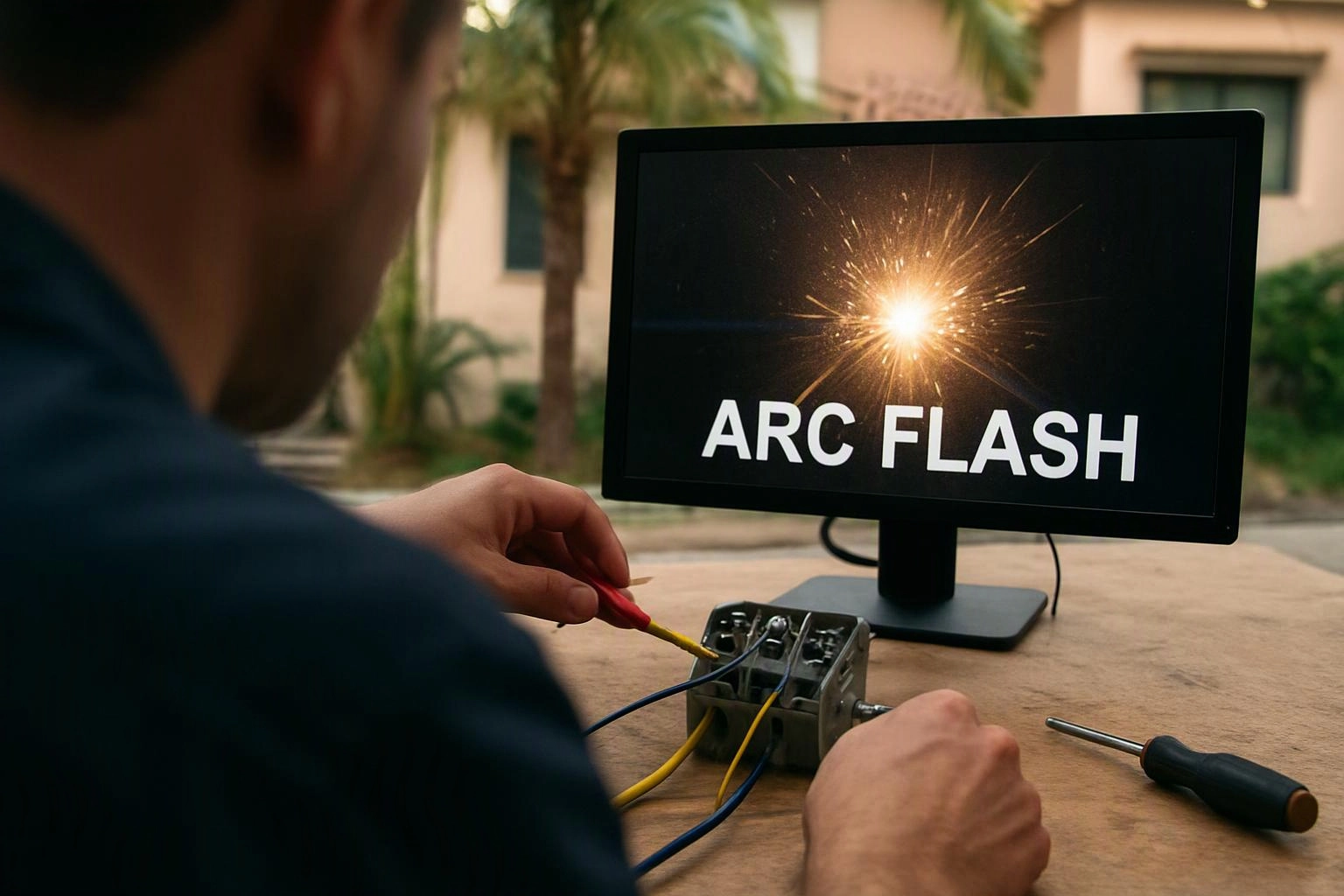
From the Earth Electric team
When we perform an Electrical Safety Inspection, we examine accessible electrical equipment for loose connections, heat damage, exposed parts, and enclosure problems that can support an arc flash. We also review protective devices and installation conditions so the inspection reflects how the electrical system operates as a whole.
Arc flash in Practice: A Real-World Example
During an Electrical Safety Inspection, a technician may find a loose conductor termination inside a panel. Continued heating and movement can damage insulation and create conditions that allow an arc flash if the conductor contacts another energized part or grounded metal.
Related Terms
Ground fault
A ground fault is an unintended electrical connection between an energized conductor and a grounded surface…
Circuit overload
A circuit overload is a condition in which connected devices draw more current than the circuit…
Wire gauge
Wire gauge is a standardized way to describe a conductor’s thickness and current-carrying capacity. The gauge…
Earth Electric
Have Questions About Arc flash?
Contact Earth Electric for practical guidance on Arc flash and related 24 hour electrician work in Miami.